
Explainer
What Are Limit Straps and Do You Need Them?
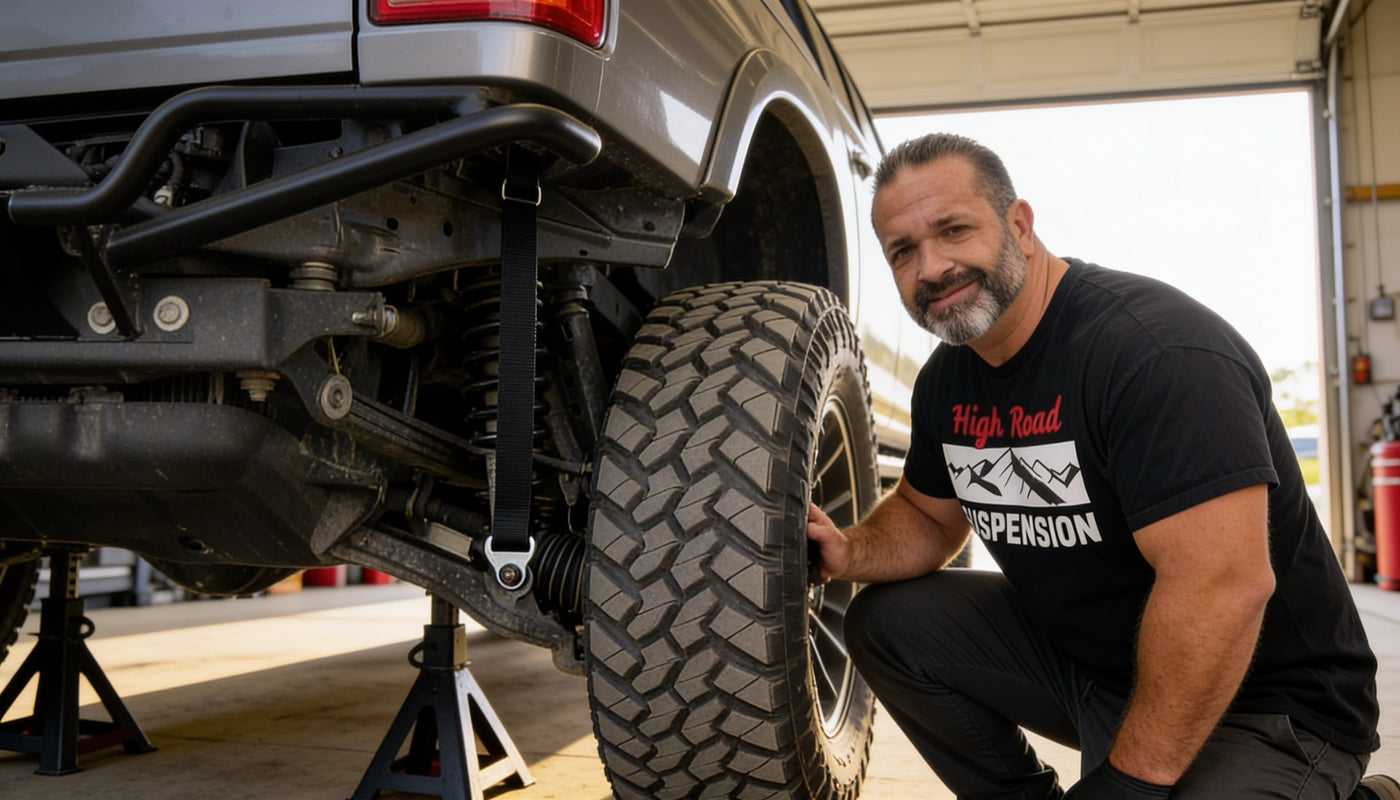
Limit straps are one of the cheapest parts you can bolt to a truck and one of the most important. They are heavy-duty webbing straps that connect from your frame to the axle or a control arm, and their only job is to stop your suspension from extending past its safe range of travel. When a wheel drops into a hole, you come off a jump, or the suspension fully unloads, the limit strap catches the droop before anything over-extends. On a hard day in the dirt, that strap can be the difference between driving home and calling a tow truck.
Why you need them
Without limit straps, full suspension droop has nothing to stop it, and that is where the damage happens. When the suspension hangs out to its absolute limit, here is what is on the line:
- Shock shafts can pull out of the shock body, destroying the seal and the shock
- CV joints can over-extend and tear boots or snap axles
- Brake lines can stretch and eventually fail
- Sway bar end links can bend or break
- Bump stops can take damage from the violent rebound after full extension
A quality set of limit straps costs a fraction of a single shock rebuild. For lifted trucks, off-road rigs, and UTVs, they are not optional. They are essential maintenance, and they pay for themselves the first time they save a shock or an axle.
How to choose the right limit straps
Length
This is the most critical measurement, so get it right. The strap needs to be long enough to allow full normal suspension travel, but short enough to stop extension before any component reaches its breaking point. My recommendation is to mount the strap tabs first, then take your measurements.
Measure the distance between your mounting points at full droop, then order straps 1 inch shorter than that measurement. Nylon webbing stretches about 1 inch per foot under load, so the straps will reach full extension naturally once they are working.
If you want to fine-tune the length, a limit strap clevis mount makes it easy. A clevis is a long-threaded mount that resembles a screw, and you can lengthen or shorten it to dial the effective strap length in or out without swapping straps.
Material and construction
Look for straps made from heavy-duty woven webbing, the same type of material used in tow straps and racing harnesses. We carry Dirt King limit straps that are quad-wrapped, which means the webbing is folded and stitched multiple times for the highest strength. Avoid cheap single-layer straps that can stretch or tear under load, because a strap that fails is worse than no strap at all.
Mounts
We carry the mounting hardware to go with them, including Dirt King flat tabs, radius tabs, and a complete limit strap mounting kit, so you can put the straps where your build actually needs them.
Hardware
Quality mounting hardware matters as much as the strap itself. Always use grade 8 bolts and hardware. It is not typically necessary, but on a hard-use rig you can even double up the mounting tabs for added strength.
Application: match the strap to your rig
Different vehicles need different straps:
- Off-road race vehicles need the highest strength ratings and often require multiple straps per corner
- Lifted trucks and SUVs typically need one strap per side, sized for their specific lift and shock travel
Installation basics
Most limit strap installations follow the same general process:
- Identify your mounting points on the frame, axle, or control arm
- With the suspension at full droop, measure the distance between mounting points
- Select the correct strap length based on your measurement
- Bolt the strap to both mounting points using the provided hardware
- Cycle the suspension through its full range to verify the strap engages before any component reaches its limit
- Torque all hardware to spec, and re-check it after the first few rides
That last step matters. New hardware settles, so a quick re-torque after a few outings is cheap insurance on top of cheap insurance.
Frequently Asked Questions
What length limit strap do I need?
Mount your tabs first, then measure the distance between your mounting points with the suspension at full droop. Order straps 1 inch shorter than that measurement, because nylon webbing stretches about 1 inch per foot under load and will reach full extension naturally. A clevis mount lets you fine-tune from there.
Do I really need limit straps on a daily-driven lifted truck?
If your truck ever sees real suspension droop, off-road, a hole, a hard dip, then yes. Full droop is what tears CV boots, pulls shock shafts, and stretches brake lines, and that can happen on a daily driver the first time a wheel really drops. One strap per side, sized to your lift and shock travel, is cheap protection against an expensive repair.
What does quad-wrapped webbing mean and why does it matter?
Quad-wrapped means the webbing is folded and stitched multiple times instead of running as a single layer. That construction gives the strap its highest strength rating and its resistance to stretching or tearing under hard load. It is the difference between a strap that holds and a strap that becomes the next thing that breaks.
The bottom line
Limit straps are some of the cheapest insurance you can add to a build, and they protect some of the most expensive parts on it. Measure carefully, use quality quad-wrapped webbing and grade 8 hardware, and size them to your rig. If you want help picking the right straps and mounts for your truck or UTV, reach out and we will get you sorted.
More Install Guides
What Is the Honest Trade-Off With a 6" Lift?
A 6-inch lift is not the same as 6 inches of ground clearance. Here is how bracket lifts and lift spindles actually create the height, an...
Read the guide ›

Best Struts, Coilovers, and Rear Shocks for a Nissan Titan XD
From budget Bilstein struts to premium King coilovers, here's how the suspension options for the Nissan Titan XD compare, and which one f...
Read the guide ›
How to Protect Your Coilovers and Shocks: Limit Straps, Bump Stops, and Covers
Your coilovers and shocks work hard and cost real money. Here's how limit straps, bump stops, and covers protect them through the full ra...
Read the guide ›