
Explainer
Leveling Kit vs Lift Kit: Which Do You Actually Need?
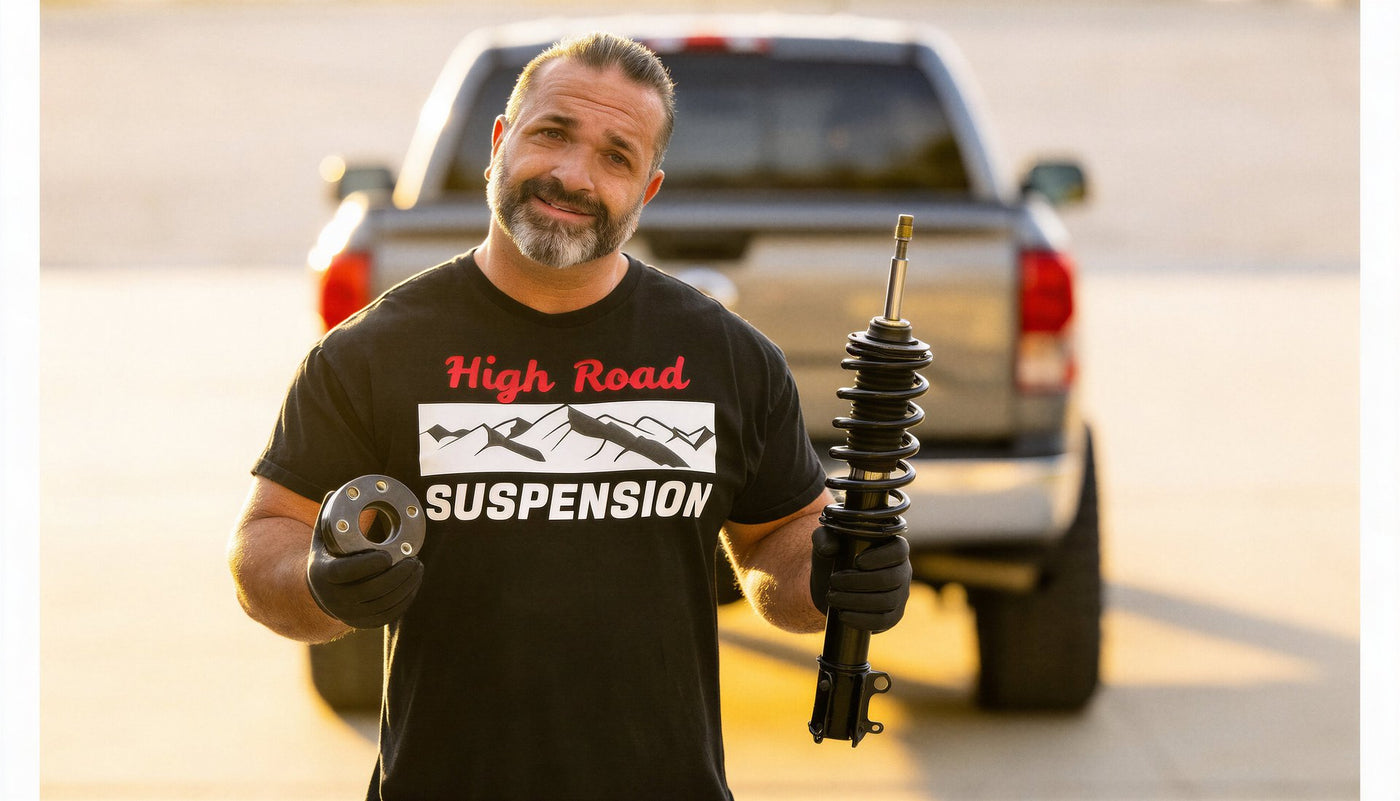
Most pickup trucks roll off the lot with a factory rake. The rear sits higher than the front, and that's on purpose: it's so the truck looks level when the bed is loaded or you're towing a heavy trailer. Empty, though, that nose-down stance bugs a lot of owners. If you've looked at your truck and thought it should sit level, or you want to clear a bigger tire, you've run into the same question everyone does. Do you need a leveling kit or a lift kit?
They aren't the same thing, and the difference comes down to what you're trying to do. This post sorts out which side of the line you're on, what each choice actually costs you, and how to buy with your eyes open.
What leveling and lifting actually mean
The line between these two is cleaner than most people expect.
Leveling brings the front of the truck up to match the rear. That's it. The most common way to do it is a leveling kit, a metal puck spacer that mounts on top of the front strut assembly. It eliminates the factory rake so the front sits level with the rear when the truck isn't under load. How much spacer you need varies by make, model, and drivetrain, and sometimes even by model year. On a Nissan Titan, for example, an 04-07 2WD wants a 2.5" leveling kit, an 04-07 4x4 wants 2", and every 08-24 Titan wants 1.5".
Lifting goes further. The moment you put the front above level with a stock rear, or you need extra parts to get there, you've crossed into lift territory. Going past level usually means adding aftermarket upper control arms for coil bucket clearance, and sometimes extended sway bar endlinks on top of that. The rule is simple: if it takes extra components to push the front above level, it's a lift, not a level.
Start with your goal, not the parts
Here's the move that saves people money and second-guessing. Decide what you actually want before you shop for parts. Almost everybody lands in one of two camps.
You just want the truck to sit level. Then you want a leveling kit, and you've got three ways to get there, from cheapest to best-riding.
A leveling spacer is the budget route. It does one job and does it fine: lifts the front to kill the rake. The tradeoff is you're stacking a spacer on a factory strut that's already aging.
Lift struts like the Bilstein 5100 or 6100 are the better middle ground. They hit your level height and replace the strut at the same time, with slightly better ride quality than stock. That matters more than it sounds, because OEM shocks and struts usually last only around 30,000 to 60,000 miles. If yours are in that window, a spacer just bolts a lift onto a worn part. A lift strut solves both at once.
Coilovers like Icon or King are the top tier. They ride dramatically better, honestly better than a new truck, while they level or lift the front. They're also fully rebuildable, so they can be the last shocks you buy. You pay for that up front.
You want bigger tires and a more aggressive stance. This is where most people actually are, even if they started out asking about leveling. A leveling kit usually won't net enough front height to clear larger tires, so if the goal is a bigger, more aggressive setup, you're really shopping for a lift. A 3" lift kit will usually clear 34-35" tires without complications. That's the honest reason most people end up lifting instead of leveling. They're after the tires and the look, and leveling alone doesn't get them there.
What happens when you push past level
Lifting buys you the stance and the tire clearance. It also starts a chain of other decisions, and it's worth knowing that chain before you commit.
Go above level and you're usually adding upper control arms for coil bucket clearance, sometimes extended sway bar endlinks too. Then there's a ceiling you can't ignore. Every 4x4 has a max recommended front lift height to keep the front axle angles healthy. On 2004-2024 Nissan Titan and Armada, that's 3" up front. On 2007-2021 Toyota Tundra, it's 3.5". (A 2WD truck has no front axle to worry about, so the limit there is just how much your aftermarket upper control arms clear, usually 3" or 3.5", and a lift spindle can add a bit more.)
Push past that max recommended height and you need a bracket lift, which lowers the front differential to keep the axle angles correct. It works, but it has real downsides. Installing one often requires cutting, and dropping the differential lower costs you ground clearance. That's why most people stop at a 3" kit instead of going to a bracket lift. The 3" number isn't arbitrary. It's the point where you get the stance and the tires without opening up a bigger can of worms.
Leveling kit vs lift kit: which one do you actually need?
So, leveling kit or lift kit? Run it through one question: what are you trying to fix?
If you just want the nose-down stance gone and the truck sitting level, you want a leveling kit. Pick the spacer if you're on a budget and your struts are healthy, the Bilstein 5100 or 6100 if you also want to replace aging struts, or coilovers if you want the best ride you can get.
If you want to clear bigger tires and a more aggressive stance, you want a lift, and a 3" kit is the sweet spot for most trucks. It's enough to run 34-35s while staying inside the max recommended front height on platforms like the Titan, Armada, and Tundra.
Most people who start out asking about leveling are really after the tires and the stance, which is why most of them end up lifting. There's nothing wrong with either answer. The wrong move is buying a leveling kit when what you actually wanted was tire clearance, or jumping to a big bracket lift when a clean 3" kit would have done everything you needed.
Still not sure which camp you're in? Browse our leveling kits if level is the goal, our lift kits if it's tires and stance, and reach out if you want a second opinion on your specific truck. We'd rather point you at the right kit than sell you the wrong one.
Frequently Asked Questions
Will a leveling kit clear bigger tires?
Usually not on its own. A leveling kit brings the front up to match the rear, but it won't net much extra height for tires. If your goal is 34-35" tires, a 3" lift kit is the usual answer.
Do I need an alignment after a leveling kit or lift?
Yes. Any time you change ride height, the alignment needs to be reset, or you'll wear your tires unevenly. We cover the why and the details in our guide to whether you need an alignment after a lift or leveling kit.
How big a lift can I run before it causes problems?
Every 4x4 has a max recommended front lift to keep the front axle angles healthy. On 2004-2024 Titan and Armada it's 3", and on 2007-2021 Tundra it's 3.5". Past that you're into bracket-lift territory, which means lowering the front differential and usually some cutting. Most owners stop at a clean 3" kit.
Do I need new struts when I install a leveling kit?
Not required, but worth thinking about. A spacer stacks on your factory strut, and OEM shocks and struts usually last around 30,000 to 60,000 miles. If yours are in that range, a lift strut like the Bilstein 5100 or 6100 levels the truck and replaces the worn part in one step.
What's the difference between a leveling kit and a lift kit, simply put?
A leveling kit brings the front up to match the rear, killing the factory rake. A lift kit puts the front above level, and usually needs extra parts like upper control arms to get there. If it takes extra components to go above level, it's a lift.
More Install Guides

Best Struts, Coilovers, and Rear Shocks for a Nissan Titan XD
From budget Bilstein struts to premium King coilovers, here's how the suspension options for the Nissan Titan XD compare, and which one f...
Read the guide ›
How to Protect Your Coilovers and Shocks: Limit Straps, Bump Stops, and Covers
Your coilovers and shocks work hard and cost real money. Here's how limit straps, bump stops, and covers protect them through the full ra...
Read the guide ›
What Are Bump Stops and When Do You Need Them?
Bump stops are the last line of defense against a bottomed-out suspension. Here's what they do, the different types, and which one fits h...
Read the guide ›