
Explainer
What Is the Difference Between a Coilover and a Strut?
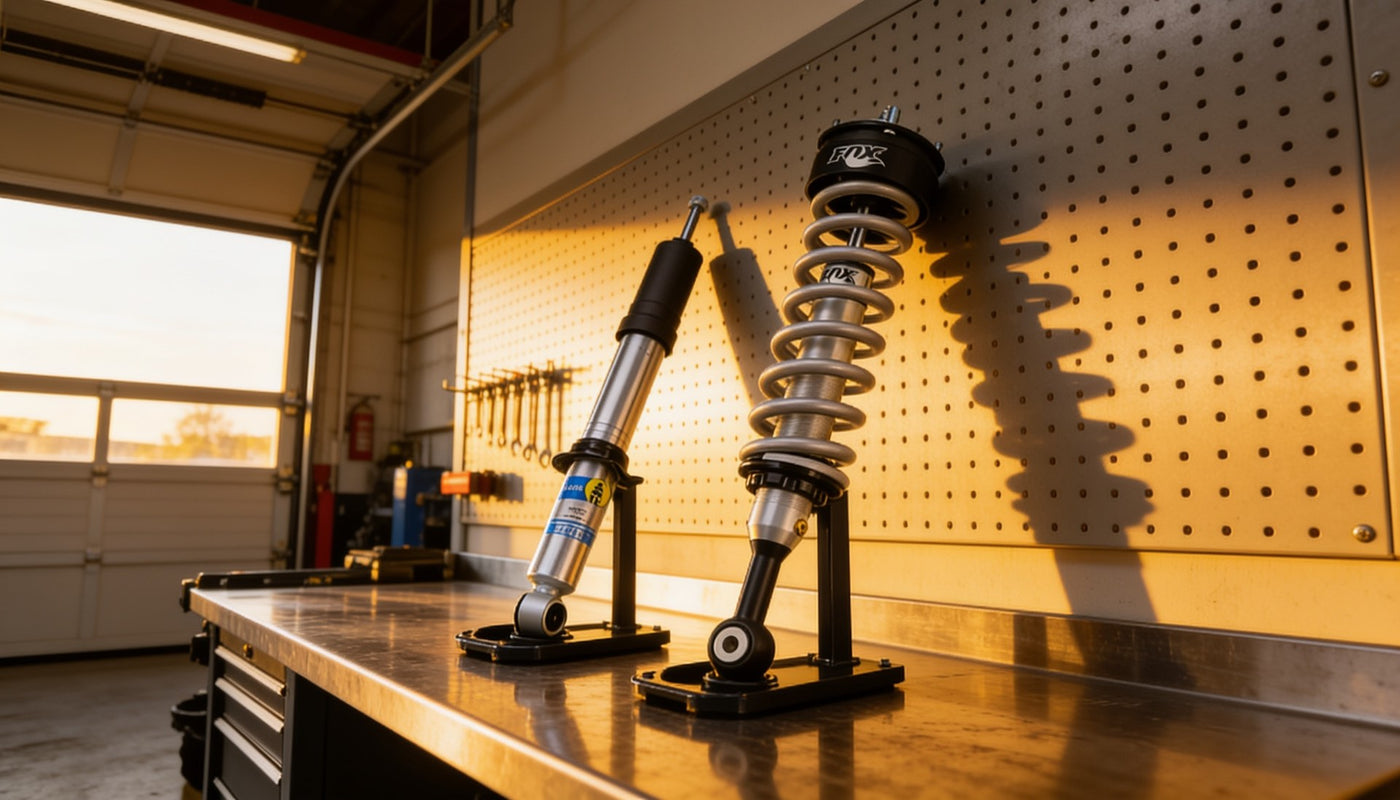
If you are shopping for replacement suspension components for your truck or SUV, you have probably come across the terms strut and coilover. While both use a spring and a shock absorber to control the vehicle's suspension, they are designed with different goals in mind.
The biggest difference is adjustability and performance. A traditional strut is designed primarily to provide a comfortable, controlled ride and support the vehicle's weight. A coilover combines the spring and shock into an adjustable suspension assembly that gives you more control over ride height and, depending on the model, damping and performance.
Let's take a closer look at the differences and which option may be right for your truck or SUV.
What Are Coilovers?
A coilover is a suspension assembly that combines a coil spring and shock absorber into one unit. The name comes from "coil spring over shock."
Unlike a basic replacement strut, many coilovers are designed with adjustable spring perches that allow you to change the vehicle's ride height. By rotating the adjustment collar, you can change the position of the spring on the shock body and fine-tune the height of the vehicle within the manufacturer's specified adjustment range.
Many performance-oriented coilovers also feature adjustable damping. Damping controls how quickly the suspension compresses and rebounds after hitting a bump. With an adjustable damping knob, the driver can fine-tune the suspension for different driving conditions and preferences.
Coilovers are also specifically valved for the application they are designed for. This allows manufacturers to match the shock's damping characteristics to the spring rate and intended use of the vehicle.
Why Choose Coilovers?
Coilovers are an excellent choice for drivers who want more control over their vehicle's suspension. They are particularly popular with people who want to:
- Adjust their vehicle's ride height
- Improve handling and cornering
- Fine-tune suspension performance
- Compensate for differences in ride height from one side of the vehicle to the other
- Build a suspension specifically around their driving style
For someone who wants more than a basic replacement suspension component, coilovers provide a level of adjustability that traditional struts generally cannot.
What Are Struts?
A strut is a structural suspension component that combines a shock absorber with the mounting points necessary for the suspension system. On many trucks and SUVs, the front suspension uses a MacPherson-style strut assembly, which incorporates the spring and shock into one unit.
The shock absorber inside the strut controls suspension movement. Its job is to keep the tires in contact with the road while controlling how quickly the suspension compresses and rebounds. The coil spring supports the weight of the vehicle and allows the suspension to move when the vehicle encounters bumps and uneven surfaces.
Traditional replacement struts are generally designed to work with the vehicle's existing spring and hardware. They are intended to restore proper suspension performance rather than provide extensive adjustability.
For most people who use their truck or SUV for commuting, highway driving, towing, or everyday use, a quality replacement strut can provide an excellent balance of comfort, control, and reliability.
When Should You Replace Your Front Struts?
Like any other suspension component, struts eventually wear out.
The lifespan of a strut varies considerably depending on the vehicle, mileage, road conditions, driving habits, and whether the vehicle is used for towing or off-road driving. It is not unusual for original-equipment struts to begin losing damping performance as mileage increases.
As the damping performance of a strut deteriorates, the suspension can become excessively soft and uncontrolled. You may notice increased bouncing after hitting bumps, more body movement when braking or turning, or a ride that feels less controlled than it used to.
Some drivers describe a worn-out suspension as feeling like they are "riding in a boat."
Worn struts are also one of the reasons many truck owners begin looking at suspension upgrades. If you are already replacing your front struts, it can be a good time to consider whether you want to remain at stock height, level the vehicle, or add lift. Our guide on leveling kits vs lift kits breaks down that decision in detail.
Stock Height, Leveled, or Lifted?
If your front struts are worn out and you are considering changing the stance of your truck, there are several options.
Stock Height
If you simply want to restore your truck's original ride height and suspension performance, a stock-height replacement such as the Bilstein 4600 is an excellent option.
The goal of a stock-height replacement is straightforward: replace the worn-out suspension components while maintaining the factory ride height.
Leveling Your Truck
Many trucks leave the factory with the front end sitting lower than the rear. This is intentional because the rear suspension is designed to carry additional weight. Once loaded, the truck will sit closer to level.
If you prefer the appearance of a level truck, a height-adjustable strut or coilover can raise the front suspension to achieve the desired stance.
The Bilstein 5100 is a popular option for this application. Unlike the 4600, the 5100 features multiple spring-perch positions that allow the spring to be installed higher on the shock body, providing a fixed amount of front lift depending on the selected position. If you go this route, we have step-by-step Bilstein 5100 install guides for popular trucks.
Adjustable Coilovers
Coilovers take adjustability a step further.
Within the manufacturer's specified adjustment range, the ride height can be fine-tuned by adjusting the spring perch. This allows you to make small changes to the vehicle's stance rather than being limited to one predetermined lift height.
This can be particularly useful because trucks are not always perfectly symmetrical from the factory. It is common for a vehicle to sit slightly lower on one side than the other.
With adjustable coilovers, you can independently adjust each front corner to help achieve the stance you want.
Spring-Loaded Options
At HIGH ROAD Suspension, we do not typically offer spring-loaded Bilstein struts. With most of the Bilstein options we sell, the existing spring and hardware are transferred from the factory strut to the new Bilstein unit.
There are companies that sell complete spring-loaded Bilstein assemblies. However, when the price approaches the cost of a quality coilover, we believe it is worth considering a true coilover instead.
For example, Eibach and Fox 2.0 coilover systems can provide additional adjustability and performance for only a few hundred dollars more than some complete spring-loaded strut assemblies.
We also offer spring-loaded Rough Country struts. These can be an option when keeping the initial cost as low as possible is the primary concern. However, in our experience, we generally recommend stepping up to a higher-quality suspension system when the budget allows.
Are Coilovers Rebuildable?
One of the advantages of many quality coilovers is that they can be rebuilt.
A rebuild typically involves disassembling the shock, replacing worn internal components and seals, servicing the fluid, and reassembling the unit to restore its performance.
Rebuild intervals vary depending on the manufacturer and how the coilovers are used. Some manufacturers recommend servicing their coilovers at relatively short intervals for vehicles that see frequent or extreme off-road use. For the average street-driven truck, many owners simply have their coilovers serviced when performance begins to deteriorate or maintenance is otherwise needed.
One potential downside is convenience.
If you do not have a local suspension shop capable of rebuilding your particular coilovers, you may need to remove them from the vehicle and ship them to a rebuild facility. You will then have to wait for the units to be serviced and shipped back.
That can leave your truck or SUV out of service unless you have another set of struts or shocks available to keep the vehicle running while the coilovers are being serviced.
Installation: Struts vs Coilovers
Installation is another important difference between traditional replacement struts and coilovers.
Many Bilstein replacement struts are sold without the factory spring installed. This means the original spring and other reusable hardware may need to be removed from the factory strut and transferred to the new Bilstein.
Because the factory spring is under significant tension, a properly rated spring compressor should always be used, and the manufacturer's installation instructions should be followed carefully.
Coilovers, on the other hand, typically come as a complete spring-and-shock assembly. This makes them more of a plug-and-play installation compared with a traditional replacement strut.
Keep in mind that installation requirements vary by manufacturer and vehicle, so always verify what is included with the specific suspension kit you are purchasing.
Which One Is Right for You?
The best choice ultimately depends on what you want from your truck or SUV.
Choose a traditional strut if:
- You want to maintain stock ride height.
- You primarily drive on the street.
- You want to restore worn-out factory suspension.
- You want a quality replacement without unnecessary adjustability.
- Keeping the cost down is important.
Consider a coilover if:
- You want adjustable ride height.
- You want to level or lift your truck.
- You want to fine-tune the vehicle's stance.
- You want improved suspension performance.
- You drive off-road or want more control over your suspension.
- You want the ability to rebuild the shock rather than replace the entire assembly.
At HIGH ROAD Suspension, we believe the right suspension setup depends on how you use your vehicle, not simply how much lift you want. A quality stock-height strut can be the perfect solution for one truck, while an adjustable coilover may be a much better choice for another.
If you are unsure which option is right for your vehicle, feel free to reach out to us. We are happy to help you choose a suspension setup that fits your truck, your budget, and the way you actually drive it.
Frequently Asked Questions
What is the main difference between a coilover and a strut?
A strut is a structural suspension unit built mainly to restore a comfortable, controlled ride at or near factory height, usually reusing the vehicle's existing spring. A coilover combines the spring and shock into one adjustable assembly that lets you change ride height and, on many models, damping. In short: a strut restores, a coilover adjusts.
Are coilovers better than struts?
Neither is universally better, they serve different goals. A quality strut is ideal for street driving, towing, and keeping stock height at a lower cost. A coilover is the better pick if you want adjustable ride height, leveling or lift, finer stance control, improved performance, or the ability to rebuild rather than replace the unit.
Can you adjust ride height with a strut?
A basic replacement strut is not designed for height adjustment. Some height-adjustable struts like the Bilstein 5100 offer a few fixed lift positions via spring-perch settings, but only a coilover gives you continuous, fine-tuned height adjustment within its range, including independently adjusting each corner.
Do coilovers ride rougher than struts?
Not necessarily. Because coilovers are valved specifically for the application, a quality coilover can ride as well as or better than a strut. Ride feel depends far more on the valving and spring rate than on whether the unit is technically a strut or a coilover.
Are coilovers rebuildable?
Many quality coilovers are. A rebuild disassembles the shock, replaces worn seals and internals, services the fluid, and restores performance. Most basic replacement struts are sealed units that are replaced rather than rebuilt, so rebuildability is one of the long-term advantages of a good coilover.
More Install Guides
What Is the Honest Trade-Off With a 6" Lift?
A 6-inch lift is not the same as 6 inches of ground clearance. Here is how bracket lifts and lift spindles actually create the height, an...
Read the guide ›

Best Struts, Coilovers, and Rear Shocks for a Nissan Titan XD
From budget Bilstein struts to premium King coilovers, here's how the suspension options for the Nissan Titan XD compare, and which one f...
Read the guide ›
How to Protect Your Coilovers and Shocks: Limit Straps, Bump Stops, and Covers
Your coilovers and shocks work hard and cost real money. Here's how limit straps, bump stops, and covers protect them through the full ra...
Read the guide ›