
Buyers Guide
Upper Control Arms for the Toyota Tundra: Buyer's & Install Guide
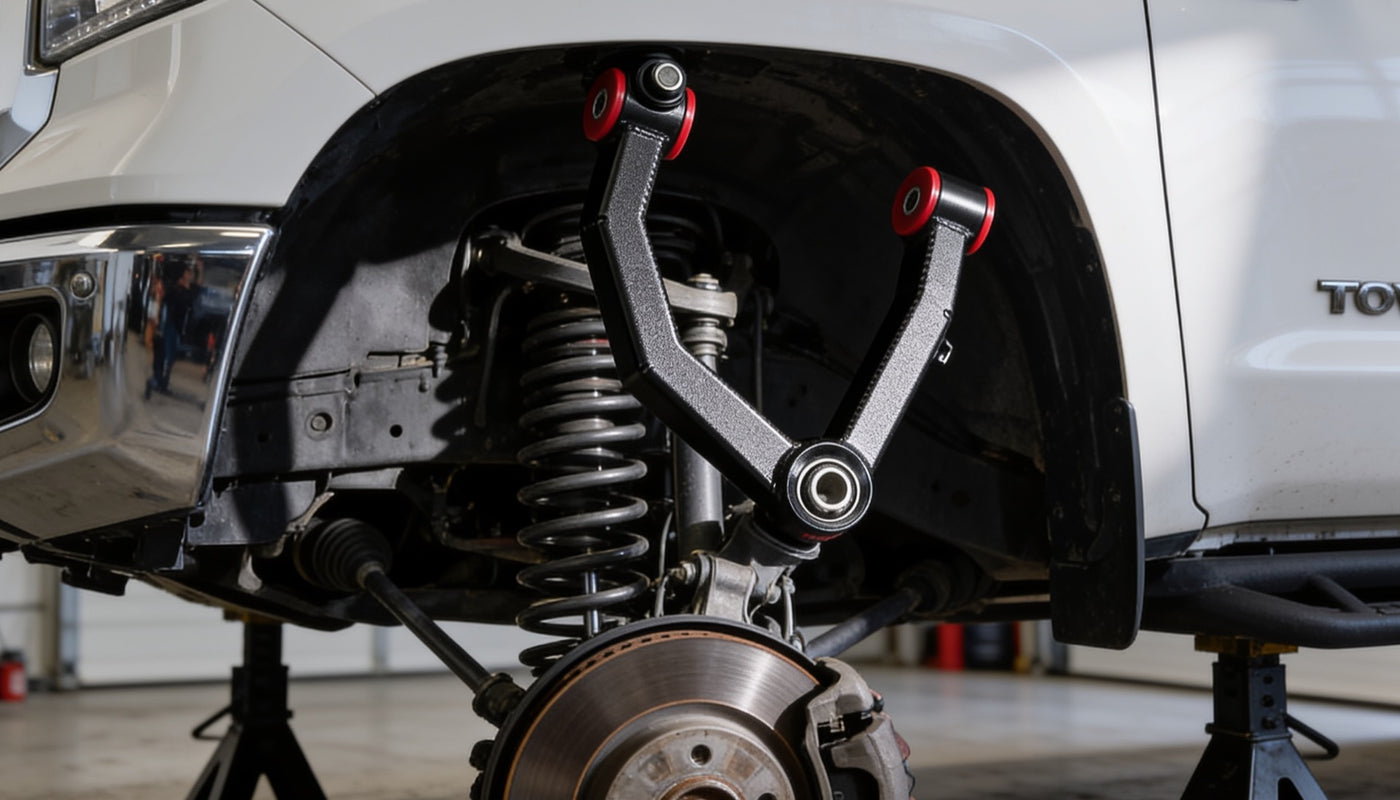
If you have lifted the front of your Toyota Tundra, you may have been told that you need aftermarket upper control arms (UCAs). But why?
When you lift the front suspension, you change the angles of the suspension components. At a certain lift height, the factory upper control arms can no longer provide the clearance, alignment adjustment, and suspension travel needed for the truck to operate properly.
As a general guideline, aftermarket UCAs are recommended when lifting a 2007-2021 Tundra more than 3 inches or a 2022-and-newer Tundra more than 2 inches. If you are still deciding how much lift you want, our guide on leveling kits vs lift kits is a good place to start.
Why Do You Need Aftermarket Upper Control Arms?
Here are the main reasons you may need aftermarket upper control arms.
1. Alignment
Lifting the front of your truck changes the geometry of the suspension. This can move the caster and camber angles outside of their factory specifications.
Incorrect alignment can cause:
- Uneven or accelerated tire wear
- Poor steering feel
- Reduced stability
- A steering wheel that does not return to center properly
Aftermarket UCAs can provide additional adjustment and help your alignment shop bring the suspension back into the proper range for your lift height.
2. Coil Bucket Clearance
As the suspension droops, the factory upper control arm can come into contact with the coil bucket. This contact can damage the control arm or coil bucket. In severe cases, repeated contact can damage the coil bucket enough to compromise the suspension.
Aftermarket UCAs are designed with additional clearance to help prevent the control arm from contacting the coil bucket.
Important: If an upper control arm requires you to trim the factory coil bucket for clearance, we do not recommend doing so. Removing material from the coil bucket can weaken this important suspension component.
3. Suspension Travel
Lifting your truck changes the operating range of the suspension. The factory upper control arm may contact the coil bucket, spring, or other suspension components before the suspension reaches its full range of motion.
Aftermarket UCAs are designed to provide additional clearance and articulation. This allows the suspension to move more freely and can improve suspension performance, especially when driving off-road.
4. Ball Joint Angle and Stress
When you lift the front of your Tundra, the factory upper ball joint operates at a more extreme angle than it does at the factory ride height. Operating the ball joint at an extreme angle can increase wear and reduce its service life.
Many aftermarket UCAs use a different type of joint, such as a heavy-duty ball joint, uniball, or Delta Joint. These joints are designed to provide additional articulation and better accommodate the suspension angles created by a lifted truck.
5. Off-Road Use and Heavy Loads
If you regularly take your Tundra off-road or use it to carry or tow heavy loads, the additional strength and articulation of an aftermarket UCA can be a worthwhile upgrade. Many aftermarket UCAs are constructed from stronger materials and are designed specifically for the increased demands of lifted and off-road trucks.
When You May Not Need Aftermarket UCAs
If your Tundra is at factory height or you are using a mild leveling kit, aftermarket UCAs may not be necessary. The need for aftermarket UCAs depends on the amount of lift, the suspension components being used, alignment requirements, and how the truck is used.
What Upper Control Arms Does HIGH ROAD Suspension Offer?
There are several aftermarket UCA options available for the Toyota Tundra. Each has different features, construction, and maintenance requirements. Here is a breakdown of the brands we offer and the differences between them.
Rough Country Upper Control Arms
Rough Country UCAs, shown here, are our most budget-friendly option.
One potential drawback is that these arms may not provide enough clearance from the factory coil bucket on some applications. This can make trimming the coil bucket necessary for installation. We do not recommend trimming the coil bucket. Removing material from the coil bucket can weaken it and compromise the strength of the factory suspension component.
Another consideration is the ball joint. Rough Country UCAs use their own ball joints, which can be more difficult to source for replacement because replacement joints must be obtained through Rough Country. The arms come with a protective cap designed to help protect the ball joint from dirt, water, and other elements.
If keeping the cost down is your primary concern, Rough Country is an economical option. However, there are other UCA options available if you want a more serviceable or higher-end setup.
Dirt King Upper Control Arms
Dirt King offers two UCA options for the Tundra: boxed uniball upper control arms and 4130 tubular upper control arms with ball joints. Both designs are stronger than the factory arms.
Dirt King Boxed Uniball Arms
The boxed arms, shown here, use polyurethane rear bushings and a uniball joint. The uniball features a Teflon lining designed to reduce noise and provide smooth articulation. These arms require little maintenance under normal conditions. Eventually, the polyurethane bushings may crack from exposure to the elements, or the Teflon lining inside the uniball may wear.
One important consideration with uniball arms is exposure to salt. If you live in an area where roads are regularly salted or your truck is frequently exposed to salt water, a uniball may not be the best choice. Salt and corrosion can cause the Teflon lining and other components of the joint to deteriorate more quickly. Because of the protruding bolt head, a protective cap cannot be installed over the uniball on this design.
Dirt King 4130 Tubular Arms
The 4130 tubular arms, shown here, use maintenance-free SilentSpin bushings and a sealed ball joint. The SilentSpin bushings eliminate grease fittings, so there is no routine greasing required, and the design is built to provide greater durability than traditional polyurethane bushings.
The sealed ball joint is designed for a long service life, and these arms include an anodized protective cap to help shield the joint from dirt, water, and other elements.
ICON Upper Control Arms
ICON offers both billet and tubular upper control arms. Both designs are stronger than the factory arms and use ICON's Delta Joint instead of a traditional ball joint or uniball.
The Delta Joint is designed to provide a large range of articulation while maintaining the durability needed for everyday driving and off-road use. ICON Delta Joints are designed for a service life of up to 100,000 miles and come with a 5-year replacement warranty.
ICON Billet Upper Control Arms
The billet arms, shown here, have an additional advantage: the rear heims can be lengthened or shortened. This provides additional adjustment for suspension geometry and makes it easier to dial in caster and camber after lifting the truck. Protective caps are also available for the Delta Joints to help protect them from dirt, water, and other contaminants.
ICON Tubular Upper Control Arms
The tubular arms, shown here, use the same Delta Joint in a tubular design, a strong option at a lower price point than the billet arms.
Total Chaos Upper Control Arms
Total Chaos offers tubular upper control arms with two different rear bushing options: polyurethane bushings and heim ends. Both options use a uniball and are stronger than the factory arms.
Like the Dirt King uniball arms, the Total Chaos uniballs use a Teflon lining designed to reduce noise and provide smooth articulation. The polyurethane version, shown here, requires little maintenance until the bushings eventually deteriorate from age and exposure to the elements. The uniball itself will also eventually require replacement as the Teflon lining wears. As with other uniball UCAs, we do not recommend this setup for trucks that regularly operate in areas where roads are heavily salted or where the truck is frequently exposed to salt water.
The Total Chaos arms with heim ends, shown here, provide additional adjustment. The heims can be lengthened or shortened to help adjust suspension geometry, including caster and camber. Because of the protruding hardware on the uniball, protective caps cannot be installed over the joint.
Hybrid Option: Converting a Uniball to a Delta Joint
There is also a hybrid option for customers who like the design of a uniball UCA but would prefer to use a Delta Joint. An ICON Delta Joint Retrofit Kit, shown here, can be used with certain uniball-style upper control arms to replace the uniball with an ICON Delta Joint.
This allows an arm such as the Dirt King boxed uniball or Total Chaos UCA to use a Delta Joint instead. For customers who want the articulation of an aftermarket UCA combined with the serviceability and durability of a Delta Joint, this can be an excellent option.
Our Top Pick: ICON Billet Upper Control Arms
Our top pick is the ICON Billet Upper Control Arm. The ICON billet arms come standard with ICON Delta Joints, providing excellent articulation and a durable joint design. They also feature adjustable rear heims, making it easier to fine-tune suspension geometry after lifting the truck.
For customers looking for a high-quality UCA with excellent adjustability and a dependable joint, the ICON billet arms are an excellent choice.
How to Install Upper Control Arms on a 2007-2021 Toyota Tundra
The following procedure covers the basic installation of aftermarket upper control arms on a 2007-2021 Toyota Tundra. Always follow the installation instructions supplied with your specific upper control arms. Torque specifications can vary depending on the manufacturer and component being installed.
Before you begin: Park the truck on a level, stable surface. Set the parking brake and chock the rear wheels. Raise the front of the vehicle and securely support it with jack stands. Never work underneath a vehicle supported only by a floor jack.
- Remove the front wheels.
- Place a floor jack underneath the lower control arm and carefully raise it enough to relieve tension on the upper ball joint.
- Using a 10mm socket or wrench, remove the ABS wire from the upper control arm.
- Remove the J-clip from the upper ball joint nut.
- Using a 19mm socket or wrench, loosen and remove the nut securing the upper ball joint to the spindle/steering knuckle. If the ball joint is stuck: reinstall the nut and tighten it only until the nut is flush with the bottom of the ball joint stud, then carefully lower the floor jack and allow the suspension to droop. Strike the side of the spindle/knuckle with a hammer until the ball joint separates. Do not strike the ball joint stud directly. Once separated, remove the nut and set it aside.
- Remove the upper ball joint from the spindle/knuckle.
- Move to the upper control arm mounting bolt. Using two 22mm wrenches, remove the nut from the long upper control arm bolt. Use one wrench to hold the bolt head while using the other to loosen the nut.
- Slide the long upper control arm bolt out of the control arm. On some Tundras, it is easiest to slide the bolt through the engine bay and then retrieve it from inside the engine compartment. You may need to temporarily remove the air filter box on the driver's side to gain enough access to the bolt.
- Remove the factory upper control arm.
- Position the new upper control arm in the factory mounting location.
- Install the original equipment (OE) upper control arm bolt through the new arm.
- Reinstall the nut on the upper control arm bolt.
- Install the new upper control arm onto the spindle/knuckle using the supplied hardware and follow the manufacturer's instructions for the ball joint or Delta Joint installation.
- Reconnect the ABS wire to the upper control arm.
- Reinstall the J-clip.
- Reinstall the front wheel.
- Repeat the procedure on the opposite side of the truck.
- Once both sides are installed, lower the truck to the ground and torque all fasteners to the specifications provided by the UCA manufacturer and Toyota. Do not guess at torque specifications. Always use the manufacturer's specified torque values for the particular upper control arm and hardware being installed.
After installation, the truck should receive a professional four-wheel alignment.
Maintenance: Replacing Ball Joints, Uniballs, and Delta Joints
One of the advantages of aftermarket upper control arms is that the joints can generally be replaced when they eventually wear out. In many cases, the control arms do not need to be removed from the truck.
Replacement procedures vary depending on the manufacturer and the type of joint being used, so always follow the instructions supplied with the replacement joint. For press-in ball joints and similar components, a ball joint press can often be rented from an auto parts store. For components that use retaining rings, remove the retaining ring with an appropriate screwdriver or pry tool before attempting to press out the old joint.
An ICON Delta Joint press tool, shown here, is highly recommended when replacing ICON Delta Joints. The specialized tool can be used with a ball joint press to help properly remove and install the Delta Joint.
Final Thoughts
Choosing the right upper control arm depends on more than simply choosing the most expensive option. Consider how much your Tundra is lifted, how you use your truck, where you live, how much maintenance you are willing to perform, and how much adjustability you want.
For a budget-conscious build, Rough Country can provide an economical option. Dirt King and Total Chaos offer strong aftermarket designs with uniball or ball-joint options, while ICON offers the Delta Joint and additional adjustability on its billet arms.
If you are running a bigger lift and want the full picture on what else your setup may need, our Nissan Titan lift buyer's guide covers the supporting components that apply to lifted trucks in general.
If you are unsure which UCA is right for your Tundra, HIGH ROAD Suspension can help you choose the right setup for your lift and how you use your truck.
Frequently Asked Questions
When do I need aftermarket upper control arms on a lifted Tundra?
As a general guideline, aftermarket UCAs are recommended when lifting a 2007-2021 Tundra more than 3 inches, or a 2022-and-newer Tundra more than 2 inches. Below those heights, the factory arms are often fine. The real answer depends on your lift height, the components you are running, and how you use the truck.
Why can't I just trim the coil bucket to fit a UCA?
We do not recommend trimming the factory coil bucket. Removing material weakens an important structural part of the suspension. If a control arm requires trimming the coil bucket to clear, that is a sign to choose an arm designed with proper clearance instead.
What is the difference between a ball joint, a uniball, and a Delta Joint?
A ball joint is the traditional, often greaseable and easily replaced joint. A uniball uses a Teflon-lined spherical bearing for maximum articulation but wears faster in salty or wet climates and cannot take a protective cap on some designs. ICON's Delta Joint aims to combine high articulation with ball-joint-like durability, rated up to 100,000 miles with a 5-year warranty.
Should I avoid a uniball UCA where I live?
If your roads are regularly salted or your truck sees frequent salt-water exposure, a uniball may not be the best choice, salt and corrosion wear the Teflon lining faster. In those climates, a sealed or greaseable ball joint (or a Delta Joint) tends to hold up better.
Do I need an alignment after installing upper control arms?
Yes. Any change to suspension geometry, including new UCAs and any lift, calls for a professional four-wheel alignment afterward to set caster, camber, and toe correctly and protect your tires.
More Install Guides
What Is the Difference Between a Coilover and a Strut?
Coilover or strut? Both use a spring and a shock, but they're built for different goals. Here's how they differ and which fits how you ac...
Read the guide ›
Bilstein 5100 Install Guide for Toyota Tundra
A full driveway install of Bilstein 5100 front struts on a Toyota Tundra, including the snap-ring lift settings for every model and the a...
Read the guide ›
Nissan Titan Suspension Lift Buyer's Guide
From leveling spacers to bracket lifts, every Nissan Titan lift option explained, plus the supporting parts you need for a safe, reliable...
Read the guide ›